video Private markets
Your Portfolio Is Missing Half The Market
In this video, Josh Hile covers:
- The Setup: What Most Portfolios Are Missing
- What Private Markets Actually Are
- Why 87% of the Economy Stays Private
- The Four Asset Classes and Their Return Profiles
- Why Correlations Have Changed the Conversation
- The Generational Shift: $124 Trillion and a New Set of Expectations
- Where We See Opportunity Right Now
- What to Watch Out For
- Call to Action
Summary
In this video, Josh Hile gives a plain-language introduction to private markets: what they are, why so much of the economy stays private, how the four main private asset classes differ, and what risks come with them. He opens with a statistic: 87% of US companies with over $100 million in revenue are privately owned.
What private markets are and why companies stay private
Josh defines a private market investment as anything not traded on a public exchange, such as a direct loan to a manufacturing company, a stake in a renewable energy project, or a direct investment in a multifamily building. These assets are valued periodically, are illiquid, and were historically available mainly to institutions.
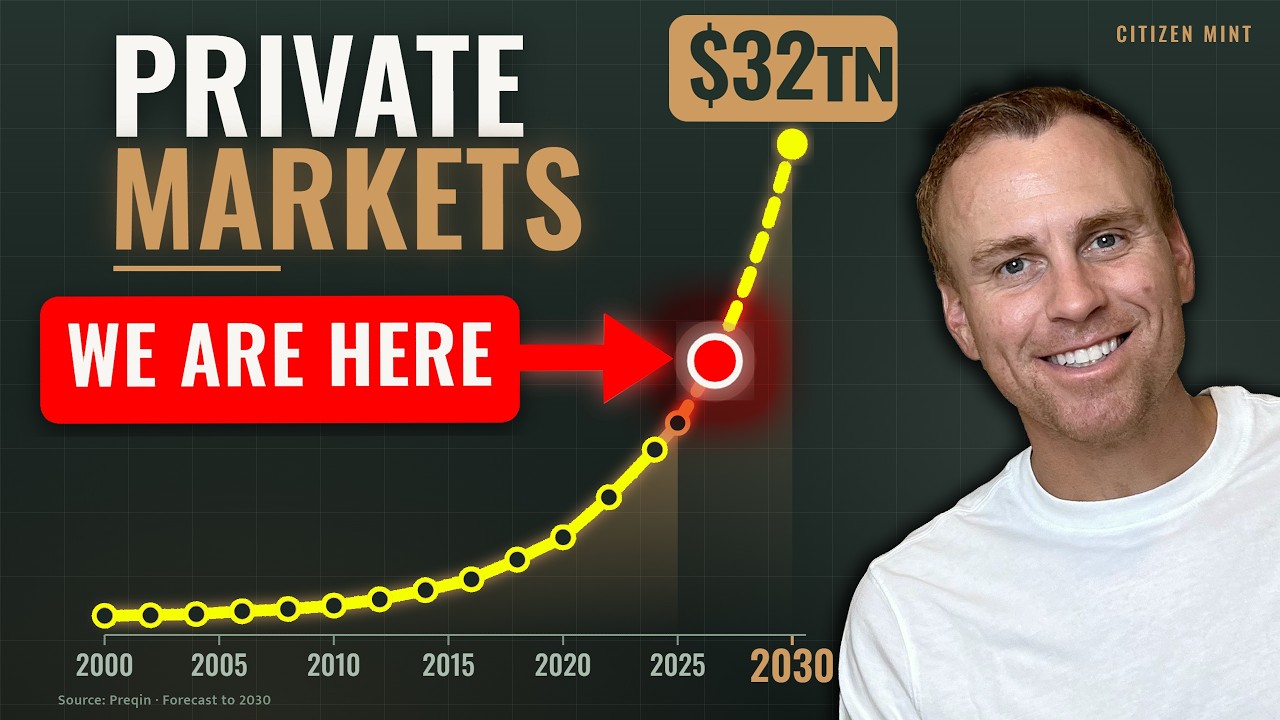
Companies no longer need an IPO to raise large amounts of capital. The video notes that in the 1990s roughly 85% of companies going public had positive earnings, compared with around 35% today, so more value creation happens before a listing. Josh cites private market capital formation growing from roughly $4 trillion in 2013 to $15 trillion by 2023. Meanwhile, seven stocks make up roughly 35% of the S&P 500, all tied to the same AI narrative.
The four private market asset classes
- Private infrastructure: long-life assets such as data centers, battery storage, renewable energy, and cell towers, often with relatively stable cash flows.
- Private credit: loans not provided by a bank or government, a market that grew as banks pulled back from mid-size lending after 2008.
- Private real estate: core stabilized properties through development projects. Josh notes public REITs have averaged about a 0.6 correlation to the S&P 500, versus closer to negative 0.1 historically for direct real estate.
- Private equity: capital to grow or improve a business for an eventual sale. Josh calls it the most correlated to public markets of the four, with reported volatility that likely understates true volatility.
Why correlations and the wealth transfer matter for advisors
The 60/40 portfolio relied on low or negative stock-bond correlation, and in 2022 both fell together. Josh cautions that infrequent valuation can make reported private market correlations look lower than true economic correlation. He also points to a projected $124 trillion wealth transfer by 2048 and a 2024 Bank of America private wealth survey in which investors aged 21 to 43 ranked US stocks last at 14%, while those 44 and older ranked them first at 41%. He outlines themes the firm is watching, including energy demand from data centers and onshoring, niche debt strategies, and workforce housing.
The risks of private market investing
The video closes on four risks: illiquidity (capital often committed for 5 to 10 years), manager selection (a roughly 20% spread between top and bottom quartile private equity managers), fees, and operational complexity such as K-1s and capital calls. Josh describes private markets as suited to long-duration capital with rigorous diligence, not a silver bullet.
This video is educational only and is not investment advice. See our disclosures.