video Private markets
There Are Fewer Stocks to Buy Today Than in 1996

In this video, Josh Hile covers:
- The Setup: Fewer Public Stocks, More Private Opportunity
- Meet Josh Hile and the Data Behind This Video
- Why the Number of Public Companies Has Been Shrinking Since 1996
- Private Markets Have Grown to $20 Trillion in AUM
- The Diversification Dimension Most Portfolios Miss
- The Hidden Concentration Risk Inside the S&P 500
- Answering the Best Counterarguments
- A Framework for Thinking About Private Market Allocation
- Call to Action
Summary
In this video, Josh Hile, CEO and founder of Citizen Mint, looks at a structural change that gets less attention than stock market concentration: the public stock market now covers less of the US economy than it used to. He draws on data from McKinsey, S&P Global, and Preqin, and acknowledges his own perspective as a private markets professional.
Why there are fewer public companies than in 1996
Josh points to a peak of roughly 8,000 stocks trading on major US exchanges around 1996, falling to roughly 4,000 by 2020. He describes several forces at work:
- Mergers and acquisitions, as larger firms absorbed smaller public companies
- Higher costs and regulatory burden of being public after the Sarbanes-Oxley Act of 2002
- A deeper private funding ecosystem, where venture capital, growth equity, and private credit can supply large amounts of capital without an IPO
He cites Stripe and SpaceX as businesses that have raised capital privately far longer than earlier generations could. The IPO has become optional for many strong businesses, so a public-only portfolio holds only the companies that chose, or were able, to go public.
How large private markets have become
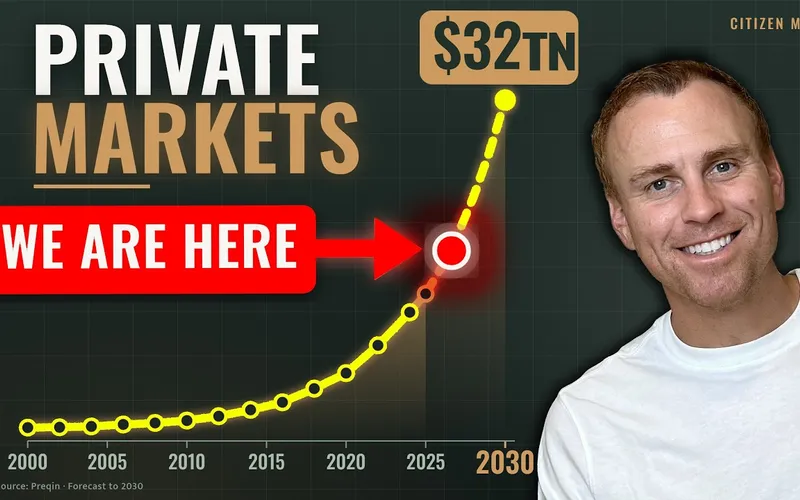
The video notes that global private market assets under management reached approximately $20 trillion by the end of 2024, which Josh compares to the total market capitalization of the S&P 500. He describes a full ecosystem (private equity, private credit, private real estate, private infrastructure, venture capital, and natural resources), each with its own return drivers, risks, and liquidity. His point is not that private markets are better, but that they are different and represent a growing share of where economic value is created.
Asset class diversification and S&P 500 concentration risk
Holding many stocks across sectors diversifies within public markets. Asset class diversification means owning exposures driven by different factors: infrastructure tied to contracted cash flows and regulated pricing, private credit tied to interest payments, and private real estate tied to rents and property values. Josh also highlights concentration inside the index. By mid 2025, the 10 largest companies represented 35% of the S&P 500, and AI related stocks had accounted for almost 75% of the index's returns since ChatGPT launched in late 2022. He frames diversifying away from that concentration as a structural portfolio decision, not a market timing trade.
Counterarguments and a framework for private market allocation
Josh addresses common objections: public alternative managers offer only indirect, fee-layered exposure; private markets are illiquid, opaque, and high fee, which is why sizing and manager selection matter; and public market capitalization is still growing, even as it concentrates in fewer companies. Rather than prescribing an allocation, he offers a framework: identify which portion of a portfolio truly has a 5 to 10 year horizon, determine which exposures are missing, and be realistic about access. He cites a top quartile infrastructure fund at a 14% IRR versus barely 3% for a bottom quartile fund, so manager selection carries real weight.
This video is educational only and is not investment advice. See our disclosures.