blog Private markets
New Tool: How privates can enhance returns
New Tool Alert! Understand the Difference Privates Can Make to Your Portfolio
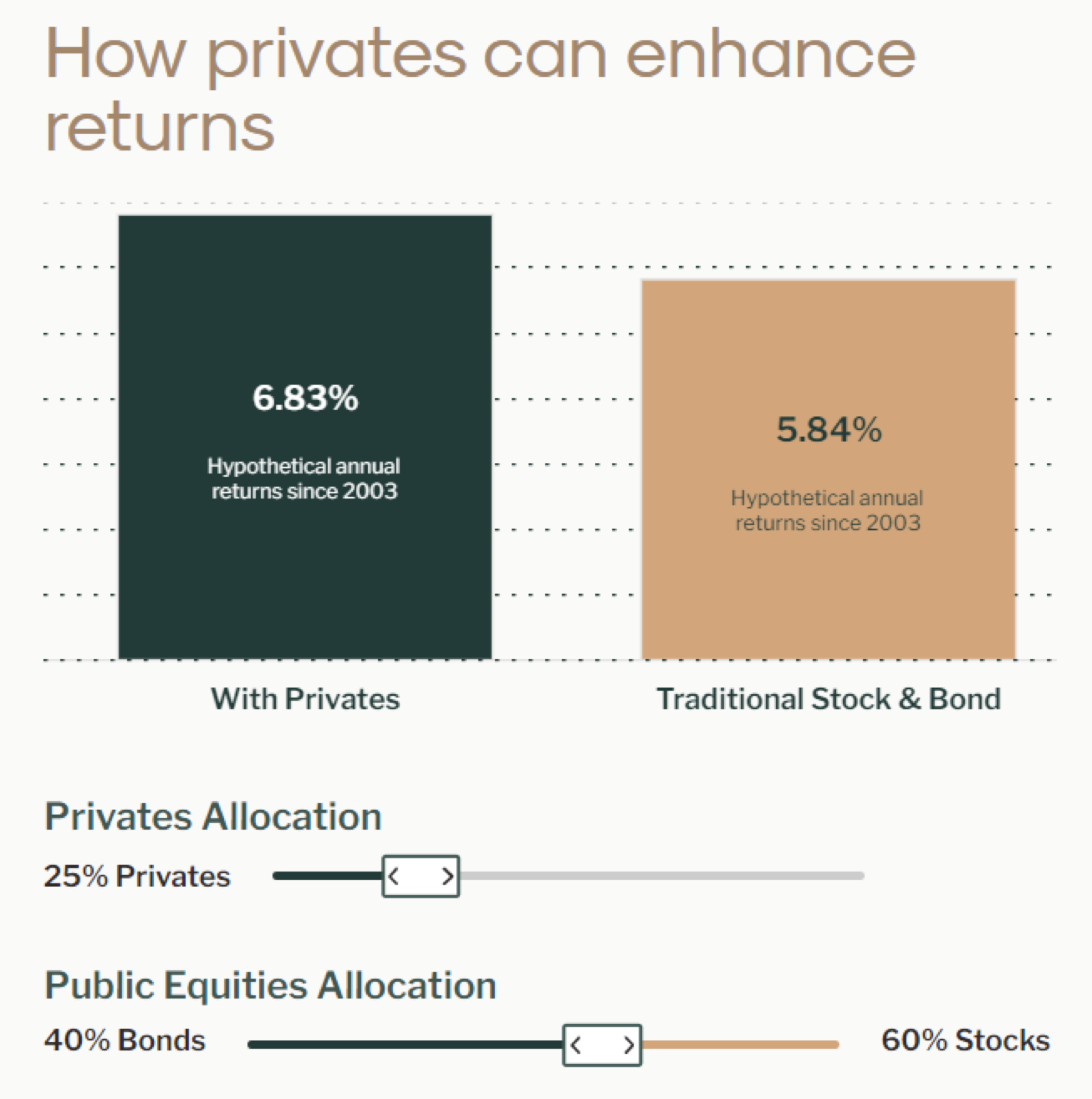
We created what we think is a handy new tool to evaluate how private markets investments could influence your portfolios over time. This tool allows you to set a traditional portfolio like a 60/40, 60% traditional stocks and 40% traditional bonds, and then review hypothetical returns as if you would have been invested in private markets over the last 20 years.
INVESTMENTS • PRIVATE MARKETS • ASSET ALLOCATION
What is this tool trying to show me?
How privates can enhance returns

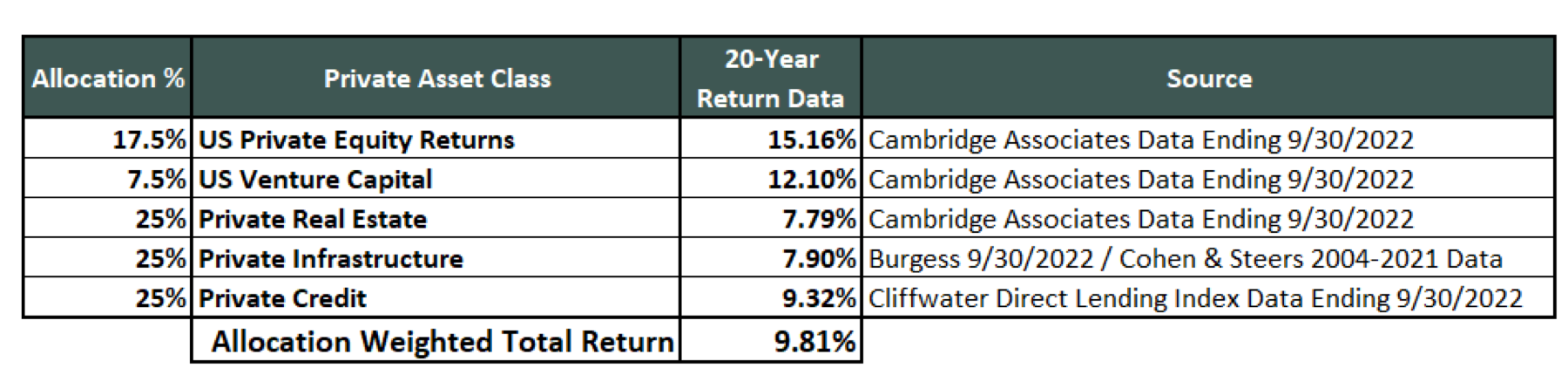
About the chartThe Traditional Portfolio represents a custom blend calculated by Citizen Mint of the S&P 500 Index and Bloomberg US Aggregate Bond Index from Q3 2002 to Q3 2022 at different stock and bond weightings (increments of 10%). Financial indices assume the reinvestment of dividends and do not reflect the impact of fees, taxes and other expenses. Indices are unmanaged, and you cannot make a direct investment in an index. Indices data was reviewed and aggregated from Ycharts.The net annualized IRR for an allocation to private capital funds is based on an endowment style allocation methodology determined by Citizen Mint. It consists on a custom blend of historical performance data calculated by Citizen Mint. Allocations to private market assets classes were as follows: private credit (25%), private infrastructure (25%), private real estate (25), US private equity (17.5%), and US venture capital (7.5%). Data sources for each of these asset classes were as follows: private credit – Cliffwater Direct Lending Index Q3 2002 to Q3 2022, private infrastructure – Burgess / Cohen & Steers Q3 2002 to Q3 2022, private real estate/US private equity/US venture capital – Cambridge Associates Q3 2002 to Q3 2022. The calculation takes a proportionate allocation from bonds and stocks when allocating to privates. All calculations are based on unaudited internal calculations and are subject to change. Numbers represented are rounded to the nearest decimal.Close
This tool clearly displays the significant positive impact that private market investments have on portfolio returns over time. As an example, let’s compare a traditional 60/40 portfolio versus the same portfolio with 25% of the assets invested in private markets. As shown above the difference in returns is roughly 1% a year which may not seem like much, but over that 20 year period for a starting $1mm portfolio it is the difference between a ~$3.75mm portfolio versus $3.11mm portfolio. Said another way, the investor would expect to have $637,000 more dollars if a part of their portfolio was allocated to private market investments.
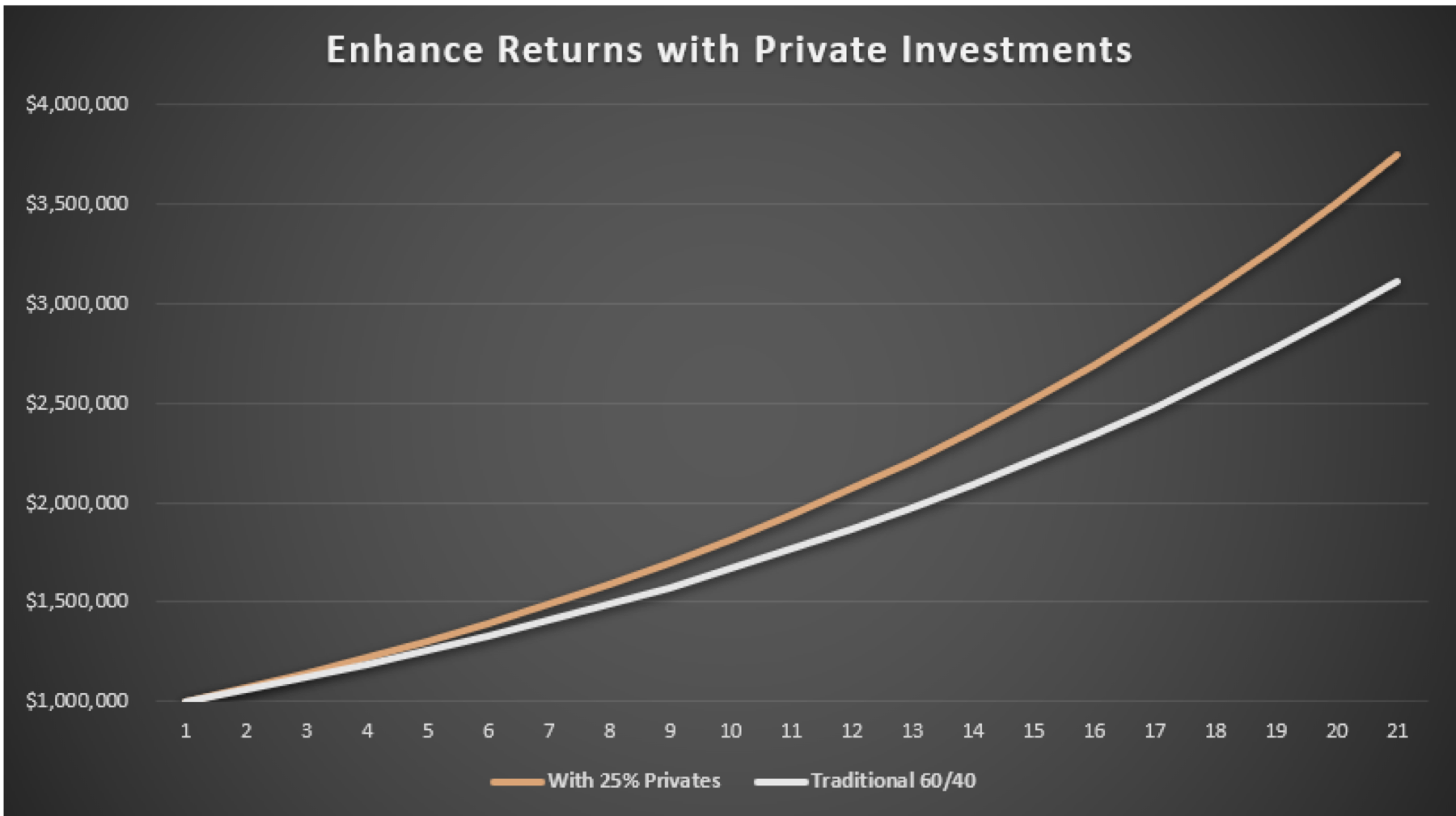
The above chart is a hypothetical return based on a 25% portfolio allocation to private markets versus a traditional 60% S&P 500 Index and 40% Bloomberg US Aggregate Bond Index portfolio allocation between Q3 2002 to Q3 2022. For more information on how the private markets and total portfolio return was calculated please review the information below.
How do the calculations work?
The Traditional Portfolio represents a custom blend, calculated by Citizen Mint, of the S&P 500 Index and Bloomberg US Aggregate Bond Index from Q3 2002 to Q3 2022 at different stock and bond weightings (increments of 10%). Financial indices assume the reinvestment of dividends and do not reflect the impact of fees, taxes and other expenses. Indices are unmanaged, and you cannot make a direct investment in an index. Indices data was reviewed and aggregated from Ycharts.
The net annualized return for an allocation to private investments is based on an endowment style allocation methodology determined by Citizen Mint. It consists of a custom blend of historical performance data calculated by Citizen Mint. Allocations to private market assets classes were calculated as follows:
The calculation takes a proportionate allocation from bonds and stocks when allocating to privates. Example: A 10% allocation to privates from a normal 60/40 portfolio would take 6% from equities and 4% from bonds.
All calculations are based on unaudited internal calculations and are subject to change.
What about the volatility of a portfolio with privates?
We estimate that the volatility of an investors portfolio will decrease, on average, between 10-30% based on their allocation to the private markets. This reduces both clients’ anxiety about their portfolio and allows them to stay invested in the market even during tough economic cycles.
Overall, an allocation to privates can enhance returns, reduce volatility and reduce investor anxiety during difficult market cycles. If you want to learn more about reasons to invest in private market opportunities review the white paper below.
Learn why private markets are an integral part of portfolio construction by downloading our Guide to Private Markets.
Want to learn more?
Be sure to download our guide on Private Market Investments